Supported housing software: what it should do, and how to choose it
What supported housing software should do for a provider in England, how it differs from care and housing management software, the data protection checks to make, and eight questions to ask before you buy.

Supported housing software is a system that supported housing providers use to record and manage the support they give residents: needs assessments, support plans and reviews, risk assessments, session records and contact logs, kept together for each resident. Good software also books reviews, shows managers what is overdue and produces the evidence councils ask for on Housing Benefit claims.
Most providers start on paper, Word documents and spreadsheets. It works, until it does not: a support plan nobody can find, a review that slipped past its date, a council asking for six months of session records by Friday. That is usually the moment people start searching for supported housing software.
This guide is for providers and managers in England, including exempt accommodation, who are weighing that move. It covers what the software should do, how it differs from the products that show up in the same searches, the data protection checks to make, and the questions worth asking any supplier, including us.
Supported housing software vs care software and housing management systems
Search for supported housing software and you will find three kinds of product. Many are built for care homes and home care, which the Care Quality Commission regulates. Others are housing management systems, built around rent accounts and repairs. Both are good at their own job, but most supported housing does not provide personal care, and rent accounts are not what a council asks to see when it checks that support is real.
| Supported housing software | Care software | Housing management systems | |
|---|---|---|---|
| Built for | Support in supported and exempt accommodation | Personal care in care homes and home care | Landlords' tenancies and property |
| Core records | Needs assessments, support plans, reviews, risk assessments, session records, contact logs | Care plans, medication charts, rotas, visit logs | Rent accounts, arrears, repairs, tenancies |
| Main evidence it produces | Proof of support for Housing Benefit and council audits | Evidence for CQC inspections | Rent and property records |
| Who uses it day to day | Support workers and managers | Carers and care managers | Housing officers and finance teams |
If a system is built around rotas and medication, or around rent and repairs, you will spend a lot of time working around it. Start by asking what the product was actually built for.
What supported housing software should do
Make the right paperwork the easy paperwork
The core job is helping support workers complete the documents your service runs on, accurately and quickly. Look for forms that match supported housing rather than generic notes fields, so that every record has what a council or inspector expects to see. Our guide to supported housing paperwork lists the documents most providers keep for each resident.
Produce the evidence councils ask for
For exempt accommodation, councils have to be satisfied that residents get more than minimal care, support or supervision. The DWP's Housing Benefit guidance for supported housing claims asks councils to look at the support actually given, and councils commonly ask for needs assessments, support plans and session records, often signed by the resident and the worker. Good software makes this evidence a natural result of the day's work, not a separate job before an audit.
Keep reviews and deadlines on track
Support plan and risk assessment reviews are easy to miss when they live in someone's diary. The software should book reviews automatically from each plan and show managers anything overdue, across every worker.
Work for support workers on the move
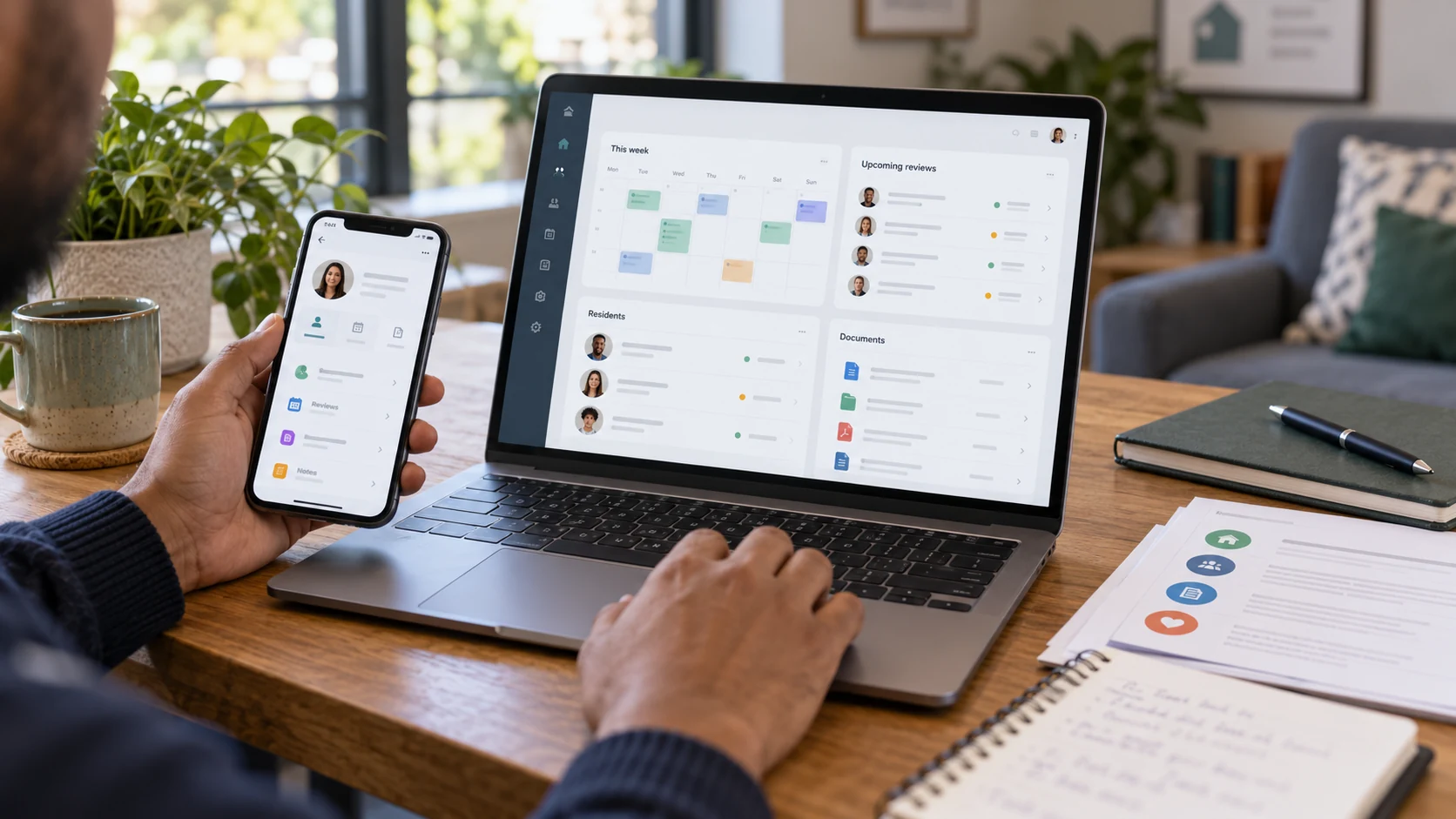
Support happens in residents' homes, not at a desk. If the system is slow or awkward on a phone, records get written up late or not at all. Ask to see a support worker complete a real record on a phone during the demo, and ask what happens if the signal drops halfway through.
Get a whole file out in seconds
Whether it is an audit, a Housing Benefit query or a resident asking for their own records, you will regularly need everything about one person, or everything from a set period. Check how long that takes, and in what format it comes out.
Control who sees what, and record every change
Support workers should see the residents they support. Managers should see the whole service. Every record should show who completed it and when, and an audit trail should show every change since. When a record is corrected, the original should be kept rather than written over.
Bring your existing records with you
Your current residents already have paper files. Ask how the system handles them: whether existing records can be brought in, how much work that takes per resident, and whether copied records can be told apart from new ones.
Be ready for licensing
The Supported Housing (Regulatory Oversight) Act 2023 gives the government powers to bring in licensing and National Supported Housing Standards for supported exempt accommodation, with Housing Benefit linked to licensing. The government's April 2026 response confirmed licence conditions including a needs assessment within four weeks of move-in, alongside standards covering person-centred support plans, complaints and a statement of purpose. It expects to consult on draft regulations in late 2026, so none of this is in force yet. Software that already captures these records will save you a scramble later. Our guide to where the Act stands has the detail.
Data protection checks for supported housing software
Supported housing records hold some of the most sensitive information there is: health, offending history, safeguarding concerns. Under UK GDPR, much of it is special category data, so it pays to ask careful questions.
- A written contract. When a supplier processes personal data for you, the Information Commissioner's Office says there must be a written contract setting out each side's responsibilities, including for any sub-processors the supplier uses.
- A data protection impact assessment. Processing special category data on a large scale is one of the situations where the ICO says you must carry out a DPIA. A good supplier will help you with it.
- Where the data goes. Sending personal data outside the UK is a restricted transfer and needs a legal mechanism such as UK adequacy regulations or appropriate safeguards. Ask where data is stored and whether any of it leaves the UK.
- Security. Cyber Essentials is the government-backed baseline scheme, and central government requires it for certain public contracts. If you are commissioned by a public body, check whether your contract asks for it, and ask suppliers what certification they hold.
- Backups and recovery. Ask how often data is backed up, where the backups are kept, and how quickly the service can be restored after a failure.
Your data if you leave the supplier
This is the question buyers most often forget, and the one that matters most if things do not work out. Your organisation stays responsible for the records, so make sure the contract says:
- the data is yours, and you can export all of it at any time, not only when you leave
- what format the export comes in: readable documents, data files, or both
- how long the supplier keeps your data after the contract ends, and how it is deleted
- whether there is a charge for getting your data out
A good test is to ask the supplier to show you a full export during the trial.
Implementation, training and support
Moving from paper is a project, even a small one. Ask:
- How do we get started? Who sets up the account, staff and residents, and how long it usually takes before support workers are using it for real.
- What training is there? A system support workers can pick up without a day in a classroom is worth a lot, because every new starter has to learn it too.
- Who do we call? How you reach support, during what hours, and how quickly you can expect an answer.
- What changes, and when? How the supplier tells you about changes, and whether anything you rely on can change without notice.
Eight questions to ask before choosing supported housing software
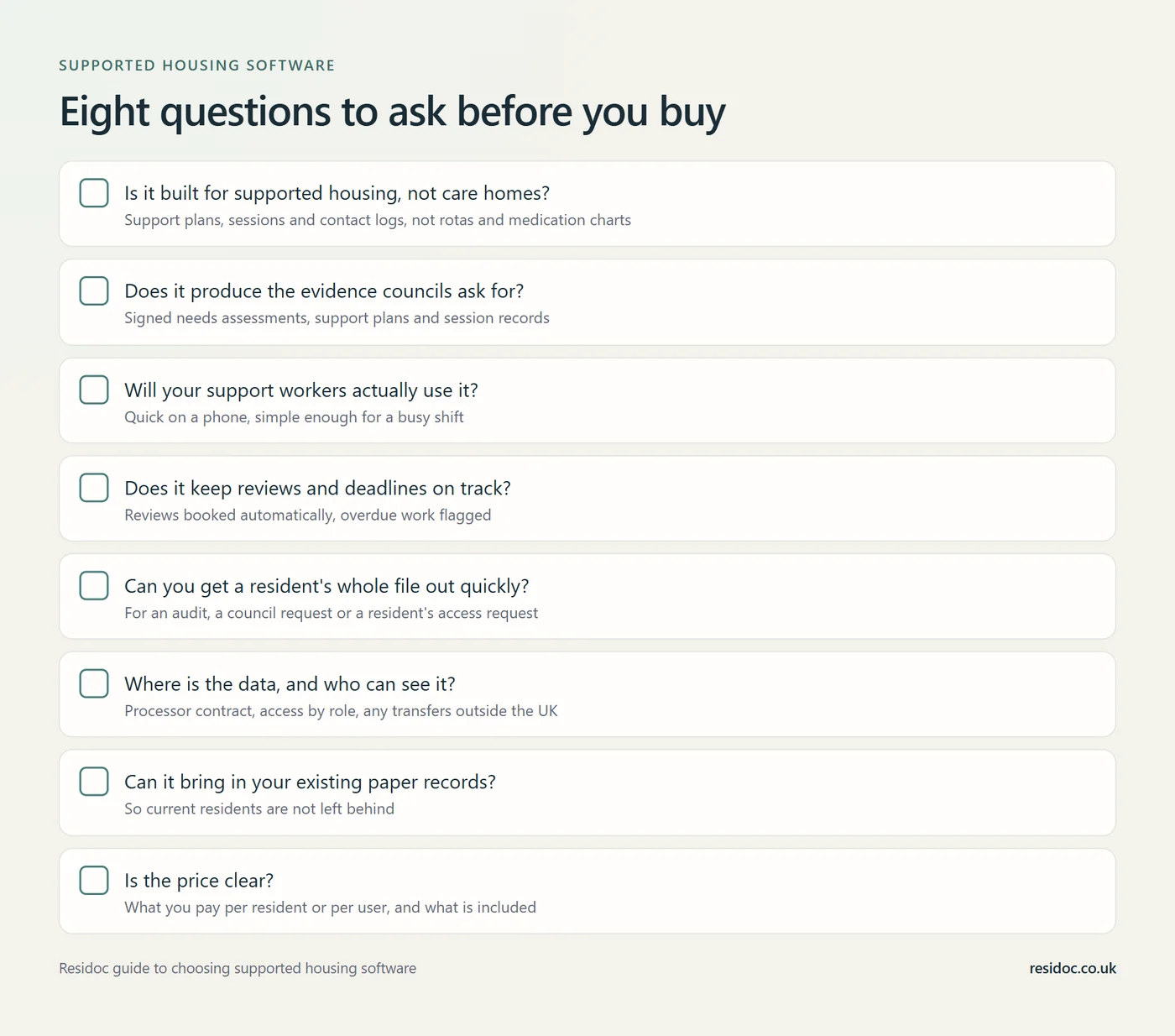
- Was it built for supported housing, or adapted from care or housing management software?
- Will it produce the needs assessments, support plans and session records your council asks for?
- Can a support worker complete a real record on a phone in a few minutes?
- Does it book reviews automatically and show managers overdue work?
- How quickly can you download everything about one resident, or one period?
- Where is the data held, who can see it, and what contract and security sit behind it?
- How do you bring your current residents' paper records across?
- What exactly will you pay, what is included, and how do you get your data out if you leave?
How much supported housing software costs
Many suppliers do not publish prices, which makes it hard to compare. Pricing is usually per resident or per user, sometimes with setup and training fees on top. Ask for the full cost in writing, including what happens to the price as you add residents or staff, and whether a yearly contract is required.
Per-resident pricing tends to suit supported housing, where staff change more often than the number of rooms does. A per-user price can make you think twice about giving relief or bank staff an account, which is how records end up written on paper and typed up later.
Where Residoc fits
Residoc was built for supported housing providers in England. Support workers complete each form as a short guided conversation, typed or spoken, from the needs assessment and licence to support sessions, reviews and the contact log. Details given once are filled into later forms, every record is signed on screen and filed to the right resident, and reviews are booked into the calendar automatically from each support plan. If the connection drops mid-session, the answers are kept on the device and sent when it comes back. Existing residents' paper files are brought across one step at a time.
Providers see the whole service: what is due, what is overdue and every record across every worker, with a full audit history of who did what and when. Any resident's file, or everything from a set period, can be downloaded in seconds, and an organisation admin can download every record at any time. Our Platinum plan adds Guide, Residoc's AI assistant, which answers from each resident's records and your own procedures, and shows where every fact came from.
Our pricing is published: from £3.25 per resident per week billed annually, with your whole team included and a free trial to start. You are welcome to put all eight questions above to us.
Frequently asked questions
What is supported housing software?
Supported housing software is a system for recording and managing the support a supported housing provider gives its residents. It holds each resident's needs assessment, support plan, reviews, risk assessment, session records and contact log together, books reviews, and produces the evidence councils ask for on Housing Benefit claims.
Is supported housing software the same as housing management software?
No. Housing management software is built around tenancies, rent accounts and repairs. Supported housing software is built around the support itself: what each resident needs, what was agreed and what support was actually given. Some providers use both.
Do we need a data protection impact assessment before buying?
If you will process special category data, such as health information, on a large scale, the ICO says you must carry out a DPIA before you start. Most supported housing providers moving their resident records onto a system will need one. Ask the supplier to help.
How much does supported housing software cost?
It varies widely, and many suppliers only quote on request. Most charge per resident or per user, sometimes with setup or training fees. Residoc publishes its prices on its pricing page.
Can support workers use it on a phone?
They should be able to. Support is given in residents' homes and out in the community, so check that a support worker can complete a full record on a phone, not just read one.
Sources
- Housing Benefit guidance for supported housing claims, DWP
- Supported Housing (Regulatory Oversight) Act 2023
- Supported housing regulation consultation: government response, MHCLG and DWP, April 2026, updated June 2026
- Contracts between controllers and processors, ICO
- When do we need to do a DPIA?, ICO
- A brief guide to international transfers, ICO
- PPN 014: Cyber Essentials scheme, Cabinet Office